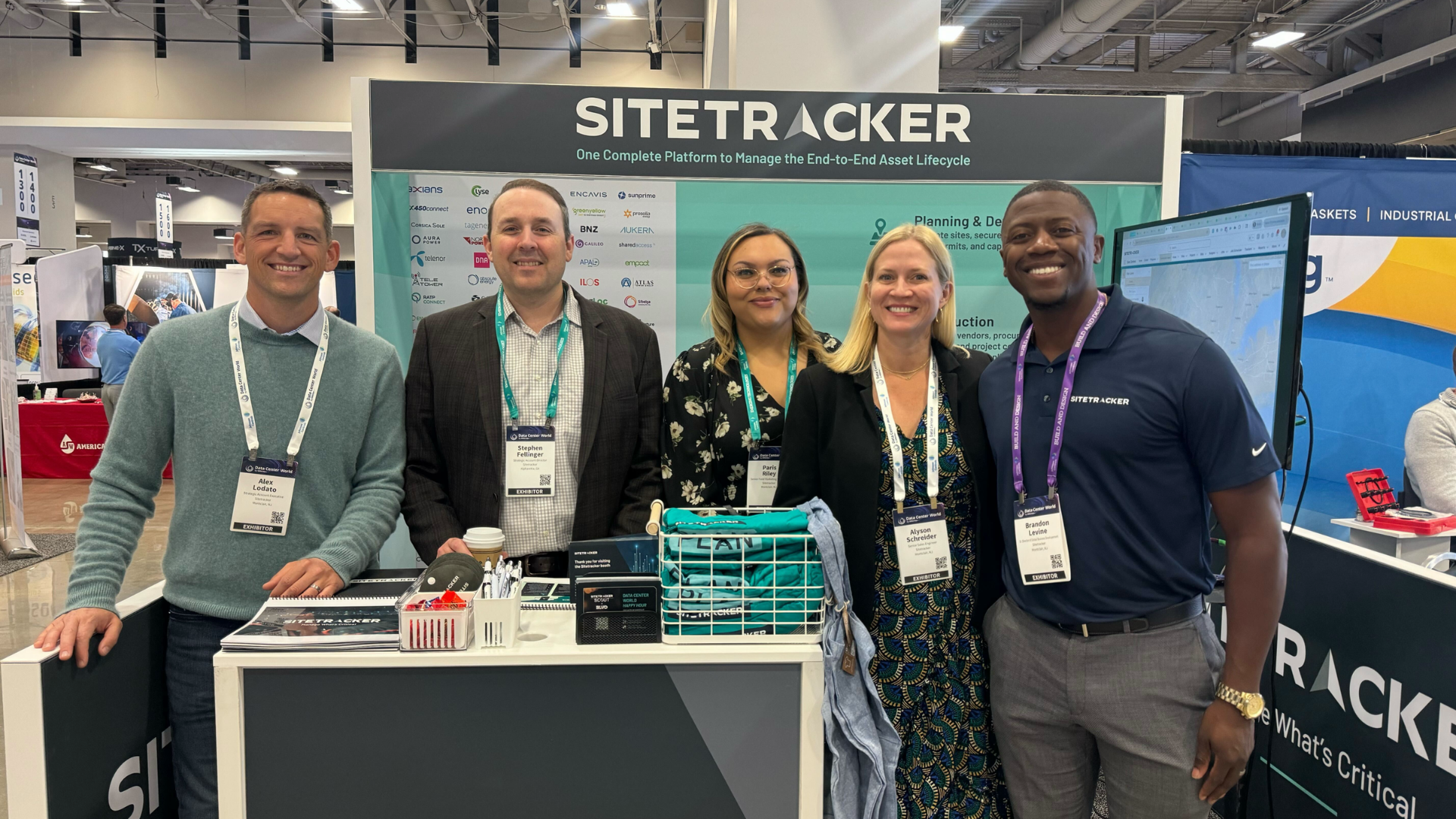
Coverage of Data Center World 2026 in Washington, D.C. surfaced a clear shift: The industry is no longer constrained by demand, it is constrained by what can actually be delivered.
While capital is abundant and AI demand is undisputed, the “sold-out” signs are appearing before the concrete is even poured. The bottleneck has moved. It is no longer a lack of interest; it is a crisis of execution capacity.
Data center growth is constrained by execution capacity: the ability to identify viable sites, secure power, and carry structured data forward before construction begins.
Operators are not debating whether to build. They are deciding where capacity can be delivered given power availability, interconnection timelines, and infrastructure dependencies.
What execution capacity means in data center development
Execution capacity in data center development is the ability to move sites from concept to construction-ready by aligning power, permitting, capital, and asset data.
Most teams assume execution starts at construction. That assumption creates blind spots.
In practice, execution breaks down earlier. Land is secured before power timelines are validated. Interconnection status is tracked outside core project workflows. Due diligence is split across teams and tools. Each step introduces risk that compounds over time.
By the time a project reaches construction, the outcome is already constrained. Schedule, capital exposure, and delivery risk are largely set upstream.
Power is now a site selection constraint
The availability of power determines whether a site is viable, not just when it can be energized.
Developers are encountering hard limits on grid capacity, and interconnection timelines now extend into multi-year horizons.
Historically, land acquisition led the process. Teams secured parcels in strategic markets and worked through power access later.
That model no longer holds.
Power access now defines whether land should be pursued at all. A site without a credible path to power is no longer just ‘delayed’ it is functionally non-viable within a standard investment horizon.
The financial impact is direct. Teams carry land that cannot deliver capacity on expected timelines. Capital is tied up in assets that cannot generate revenue, while competitors secure sites with earlier access to power.
This is why the market focus has shifted toward locating stranded or accessible power rather than simply acquiring land.
The Execution Gap: Why Projects Break Down Before Breaking Ground
Most data center delays originate in fragmented site selection and early-stage coordination, not in construction execution.
Early-phase execution is managed across a patchwork of tools. Spreadsheets track site pipelines. Email and shared drives hold due diligence documentation. GIS platforms provide spatial insight but operate outside delivery workflows. Each tool captures part of the picture. None coordinate the dependencies that determine whether a project can move forward.
Those dependencies include interconnection studies, permitting milestones, capital approvals, and feasibility decisions. When they are tracked independently, risks surface late.
The result is a predictable collision. Issues that should be identified during site evaluation only surface when timelines are compressed and options are limited. By the time a shovel hits the dirt, the project is already stalled by constraints introduced months earlier.
AI is Moving the Complexity to the Starting Line
AI has fundamentally altered the DNA of data center infrastructure.
Facilities are shifting from general-purpose environments to tightly integrated compute systems. Training and inference workloads have different requirements for power density, cooling design, and network architecture.
This complexity shows up earliest in development. Site selection decisions now need to account for higher density power requirements, more stringent cooling constraints, and campus-level infrastructure planning. These aren’t independent variables anymore; they are a single, high-stakes equation. If you solve for power without solving for liquid cooling at the same moment, the site is effectively obsolete before it’s built.
When these decisions are made without structured execution systems, risk compounds. Teams are attempting to deploy more complex infrastructure while relying on the same fragmented processes used for simpler builds.
Asset management starts in development, not operations
Asset management in data centers is determined during development, not after commissioning.
Asset structure, documentation, and dependencies are defined during site planning, design, and early procurement decisions. These are the moments when equipment hierarchies are established and long-term maintenance requirements are set.
When this information is not captured in a structured system, it becomes fragmented. Operations teams inherit static documents, incomplete asset records, and missing configuration history. The system of record is assembled after the fact rather than carried forward from the beginning.
The consequences are operational and compound (or surface) quickly across the spectrum. Troubleshooting takes longer because data is incomplete. Maintenance planning is less precise because asset relationships are unclear. Service levels are harder to maintain because the underlying system lacks continuity.
Asset management must be viewed as a development discipline, where long-term operational performance is dictated upstream by how effectively asset data is structured and preserved from day one.
Why disconnected early-phase systems do not scale
The common toolset for early-stage development reflects how the process evolved, not what it now requires.
Spreadsheets are flexible and familiar, but they do not enforce structure or manage dependencies. CRM systems track opportunities, but they are not designed to handle technical workflows or infrastructure constraints. GIS platforms provide spatial insight, but they sit outside the execution layer. Construction tools introduce structure, but they activate too late to influence site viability.
Each tool solves a specific problem. None coordinate execution across the lifecycle.
This creates a structural gap. Site identification, power validation, permitting, and asset definition are managed in parallel systems. The relationships between them are maintained manually, if at all. As portfolio scale increases, this gap becomes a primary source of delay and risk.
Tools that manage records in isolation cannot coordinate the complex dependencies of today’s modern build. When site validation, power, and permitting live in parallel silos, the relationships between them are not managed, they become hidden liabilities.
The Rise of Lifecycle Execution: Bridging the Gap from Site to Asset
A lifecycle execution platform does what fragmented tools cannot: connecting site selection, interconnection tracking, permitting workflows, and asset structure into a single system of record.
This isn’t about adding more tools; it’s about providing the coordination that scaling developers currently lack. While spreadsheets offer flexibility and GIS offers insight, neither provides the execution control needed when power is scarce and timelines are tight
They fail because they do not connect early decisions to long-term outcomes. A decision made during site evaluation should influence construction planning and operational readiness. Without a connected system, that continuity is lost.
The Execution dividend: turning coordination into capital efficiency
When early-phase execution is managed as a system, the metrics for success fundamentally shift.
Interconnection tracking moves from a spreadsheet to a strategy, surfacing deeper visibility, allowing teams to avoid committing to sites that cannot deliver power within required timelines. Due diligence moves from “patchwork” to a standardized engine, accelerating the path to construction-ready status. Most importantly, asset data is captured at the source and carried forward, enabling a clean transition into operations.
This type of carefully coordinated continuity doesn’t just improve workflows, it directly compresses the time to revenue and secures the long-term reliability of the infrastructure.
The takeaway here is this: The constraint in U.S. data center growth is not demand, capital, or construction capacity.
It is whether teams can identify viable, power-ready sites, validate constraints early, and carry structured asset data forward before they break ground. Operators that win will be those who eliminate failure earlier in the lifecycle.
FAQs
Power availability and interconnection timelines determine whether a site can move forward.
Site selection, power studies, and permitting are managed in disconnected systems, which leads to missed dependencies and late-stage rework.
Execution capacity is the ability to align land, power, permitting, and asset data to move sites into construction without delay.
Land must be evaluated alongside power access, grid timelines, and infrastructure constraints.
Asset structure and documentation are defined during development. Without early capture, operations teams inherit incomplete data.