Here is our forecast, stated plainly: your organization will run on both a frontier LLM like Claude and Sitetracker Scout. Not one or the other. Both.
Claude is the most capable reasoning engine most enterprises have ever had access to. But buying licenses and declaring victory is not an AI strategy. An engine without a vehicle moves nothing. What determines whether AI transforms your operations is everything wrapped around the model: the grounding, the guardrails, the workflows, and the management layer that turns raw intelligence into a business asset.
This is the playbook for building that vehicle.
We Have Seen This Movie Before
Twenty years ago, every major business process in infrastructure ran on Excel. Project tracking, forecasting, closeouts, financials. Technically it worked. Practically it was broken formulas, fragmented versions of the truth, and zero governance. We know this history intimately because Sitetracker has spent the last decade migrating customers off exactly those workbooks.
Every business process can be run on Excel. Poorly.
Deploying a raw LLM chat interface across your enterprise recreates the spreadsheet era with higher stakes. Individual power users build clever prompts that live and die in personal chat histories. Nothing is vetted, shared, or standardized. The intelligence your best people generate never becomes institutional. You displaced spreadsheets with a purpose-built system of record for a reason. The same reasoning applies to agentic workflows.
Probabilistic Means ‘Probably’
There is a deeper reason raw LLM deployments struggle in operations, and it is in the math. Large language models are probabilistic systems. Every answer is the most likely one, which means every answer is a probably. Probably the right object. Probably the right filter. Probably the update you intended.
‘Probably’ is a superpower for drafting, brainstorming, and analysis. It is unacceptable for a system of record. Your lease obligations, payment milestones, and closeout approvals do not run on likelihoods. No amount of prompting turns a probabilistic engine into a deterministic one, so the answer is architectural. You constrain the ‘probably’ on three sides:
- Grounding narrows what the model can be wrong about, by giving it your actual data model instead of letting it infer one.
- Fail-closed controls ensure that when the model is wrong anyway, nothing in your system of record changes without a human saying yes.
- Provenance means every answer carries its receipts. You can trace what the agent queried, what it saw, and how it got to its conclusion, so trust is inspectable instead of assumed.
Anything that must be bulletproof and deterministic still runs as a workflow in the platform. The model reasons; the system of record executes. The five gaps below are what happens when deployments skip this architecture, and how Scout closes each one.
Five Gaps That Open When LLMs Deploy Ungoverned
1. The Blank Page Problem: 20% Adoption Is Not Transformation
A blank chat box is a power tool for your most tech-savvy 20%. For the other 80%, including field users already skeptical of new technology, it is a wall. They do not know what to ask, so they ask nothing, and the licenses you paid for sit idle.
Scout eliminates the blank page by delivering AI in context, directly inside the Sitetracker surfaces where work already happens. Users see action-oriented prompts tied to the record in front of them: Re-forecast Site, Identify Project Risks, Draft Stakeholder Update. Adoption stops depending on prompt-engineering talent and starts following the workflow. That is how you operationalize 100% of the workforce instead of accelerating an isolated top slice.
2. Blind Queries: Fluent, Confident, and Wrong
Point a general-purpose LLM at your production data and it will guess at your schema. It will produce fluent answers that are confidently wrong, tripped up by hidden filters, multi-currency math, date logic, and the hundred edge cases that define real operational data. Fluency without grounding is the most expensive failure mode in enterprise AI, because wrong answers that sound right get acted on.
This is not hypothetical. A renewables customer of ours recently ran this exact experiment, connecting a frontier LLM directly to their Salesforce sandbox. Their own assessment: the model goes in blind, works through more than a thousand objects and hundreds of fields per object trying to infer what everything means, takes its time learning, and leaves them more exposed to mistakes along the way. The model was not the problem. The missing map was.
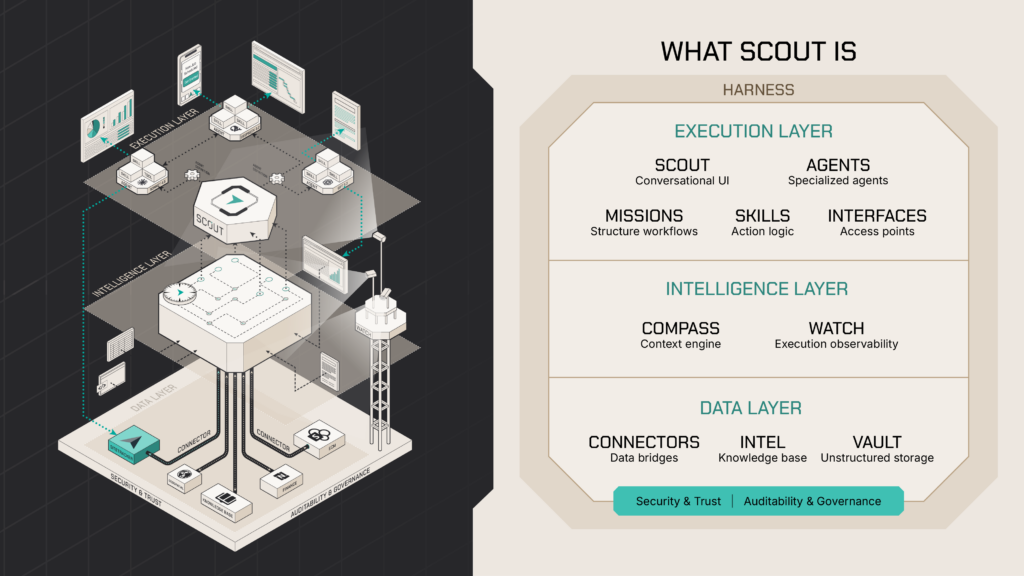
Compass is that map. It grounds every query in Sitetracker’s native data model and an industry-tuned ontology: which objects matter and which are empty stubs to ignore, which of the six manager fields is the one your organization actually uses, and what your teams mean when they say builds or deployments instead of projects. The model does not guess your objects, fields, or business logic. It knows them. The result is one-shot accuracy on the questions that actually run your business, and dramatically fewer tokens burned on retries and corrections.
3. Unchecked Writes: Draft Should Never Mean Delete
General-purpose agents overshoot. Ask for a draft and get a created record. Ask for a review and get a bulk update. When an agent has write access to your system of record, “usually gets it right” is not a security model.
Scout operates fail-closed. Every create, update, and delete requires explicit user confirmation before it touches your data. The agent proposes; the human disposes. This is the difference between an assistant you supervise and a liability you audit after the fact.
4. Logs Are Not Management: The Missing Layer Above the Model
Enterprise LLM offerings ship with audit logs, and logs matter. But a log is a compliance artifact. It tells you what happened. It cannot tell you whether the answer was correct, whether the spend produced a business outcome, or whether quality quietly degraded when the model version changed. You would never hire an employee without a manager. You cannot deploy an AI agent without one either.
Scout’s Watch module is that manager. It provides the capabilities no raw LLM deployment offers today:
- Spend-to-outcome tracking. See exactly who is consuming credits, on what topics, and whether that spend is driving results like completed closeouts, not just conversation volume.
- Automated evals and continuous probes. Watch runs your hardest business questions against the system on a schedule. When models update or your data graph changes, you find out your intelligence degraded before your users do.
- Provenance on every answer. Full traces of what each agent queried, what data it saw, and how it reached its conclusion. When someone asks why the AI said what it said, you have an answer instead of a shrug.
- Workflow observability. Watch benchmarks agent performance against human operational activity in Sitetracker, so ROI is measured, not asserted.
This is the layer that turns AI from a monthly expense into a managed, improving asset on your balance sheet.
5. Build-It-Yourself Agents: A High-Risk Hobby for Your IT Team
Relying on raw Claude means your IT organization builds, maintains, and re-engineers every workflow from scratch, then rebuilds it when the model updates. That is a permanent internal software project disguised as a subscription.
Scout ships turnkey Industry Agents built for asset-intensive operations. A Lease Extraction Agent that parses site leases into structured Sitetracker fields and flags hidden risk terms. A Project Closeout Agent that audits documentation, checks site photos against requirements, and automates approvals. Workflow Agents that run operational health checks continuously, surfacing risk without anyone typing a prompt. Vendor-supported, upgraded with the platform, grounded in your data from day one.
Harness the Engine
The organizations that win with AI will not be the ones with the most licenses. They will be the ones that gave a frontier model the grounding, guardrails, and management to do real operational work at scale.
Use Claude for what it does uniquely well: individual authoring, analysis, and general-purpose reasoning. Standardize on Sitetracker Scout as your Agentic Operating Platform to ground that intelligence in your data, govern its actions, measure its output, and compound it into organizational capability.
An engine is potential. A vehicle is progress. Use the vehicle.