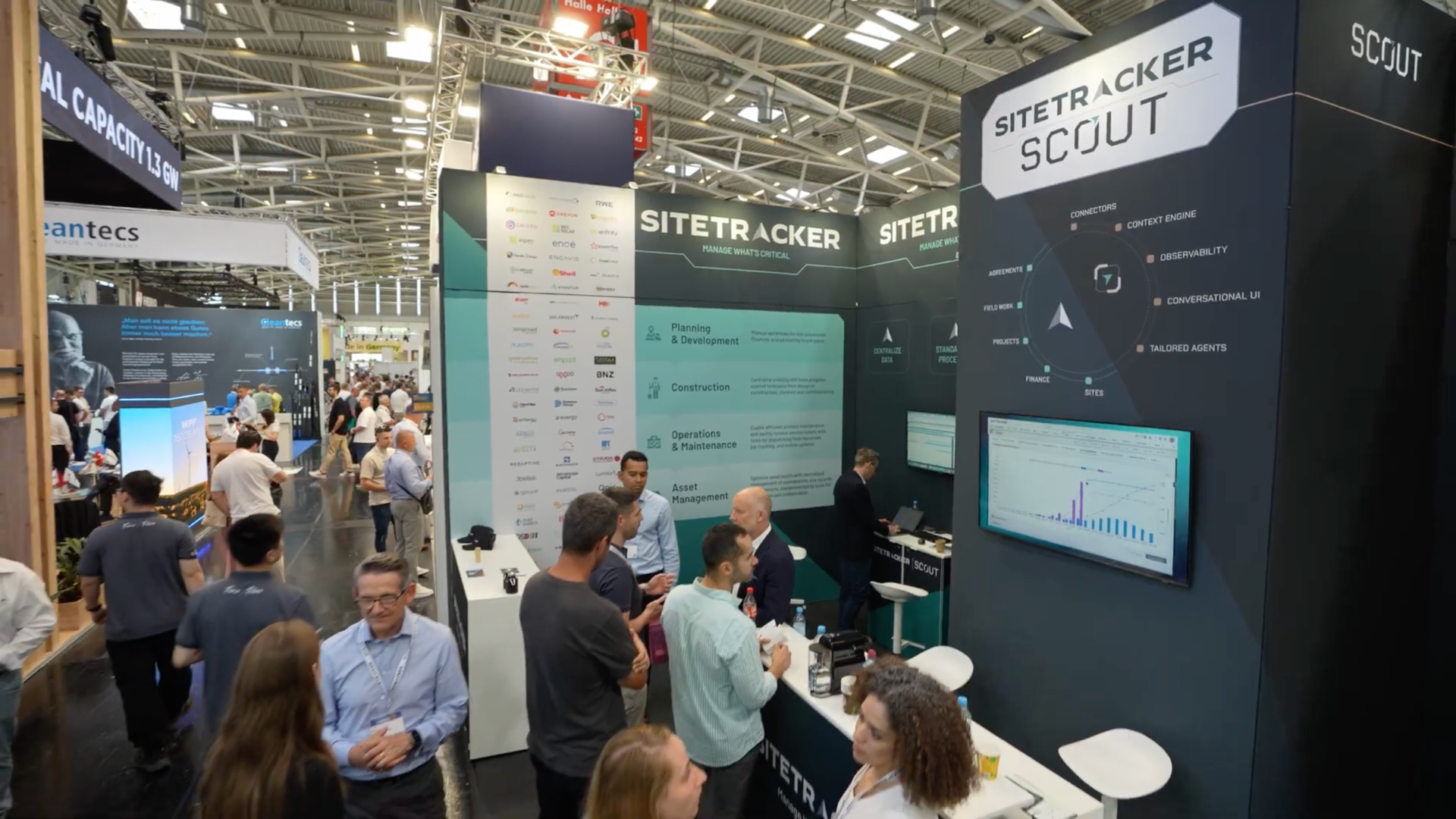
I recently sat down for a conversation with PES Solar about a question facing nearly every renewable energy leader: How can we deploy capital faster, meet critical delivery milestones, and scale operations without increasing headcount at the same rate?
My short answer is that AI can help, but only when it is grounded in accurate, contextualized operational data and applied to real business bottlenecks.
Previous generations of technology often gave us a digital version of existing work, a smart filing system. AI can change the work itself by automating processes, identifying risk sooner, and focusing teams where they can have the greatest impact.
The AI Efficiency Frontier in renewable energy
The Efficiency Frontier is the point at which an organization can increase portfolio volume without increasing headcount proportionally. It matters because deployment targets are accelerating while operational talent remains constrained.
Reaching that frontier requires AI and a system of record to work together. A system of record holds the truth but depends on people to keep it current and act on it. AI without that foundation can lack the context needed for consequential decisions.
Together, they create a different operating model. AI monitors data and surfaces risk; people remain the decision owners, with calibrated oversight that builds trust.
Renewable energy AI must be grounded in a system of record
AI is only as effective as the data it works with. If the underlying information is fragmented, incomplete, or outdated, AI will magnify those weaknesses.
The core Sitetracker platform gives infrastructure companies a structured system of record. Sitetracker Scout AI adds intelligence to that foundation, grounding its work in each customer’s projects, milestones, asset history, and workflows.
Context is essential. A permit status matters in relation to the commercial operation date (COD), contractor mobilization, and other dependencies. Regulated businesses must also know what decision was made, when, by whom, and using which data.
Where AI creates value before and after COD
The value story divides clearly at commercial operation.
Before COD, AI was an accelerant. Every day between ready-to-build and operation is capital deployed but not generating a return. AI can flag permitting, interconnection, contractor, and schedule risks early enough for teams to intervene.
This creates greater COD certainty and can help organizations:
- Identify permitting and scheduling bottlenecks earlier.
- Prioritize projects with the greatest delivery risk.
- Automate repeatable steps and trigger follow-up workflows.
- Shorten the path from capital commitment to operating assets.
After COD, AI becomes a continuous intelligence layer to mitigate operational risk. Asset managers need to see sooner. An early degradation signal may be easier and less costly to address than one discovered later.
Real-time information from sensors, drones, and inspections can be evaluated alongside asset, warranty, and service data. Scout AI can then initiate workflows for inspection, maintenance, or service. Over time, data continuity across development, construction, and operations can reveal relationships that would otherwise remain hidden.
What separates industry-specific AI from a generic tool
Generic large language models can summarize documents and produce impressive demonstrations, but they require added context that’s not inherently baked in. Infrastructure programs are long-running and interdependent. Durable value comes from maintaining context across project state, milestone dependencies, contractor performance, and asset history, not from answering an isolated question.
The evaluation test I recommend is not, “Does this demo look impressive?” It is, “Can this platform synthesize a complex program and surface a risk my team might otherwise miss until it becomes expensive?”
When renewable energy companies invest in AI, they can’t compromise on control. They need full oversight of what data is being accessed, by whom, and for what purpose. Scout AI delivers that oversight from the ground up: local data residency, a contained ring VPC, a zero-training policy, and admin governance at the user level that mirrors the permissions in the Sitetracker core platform. Users access only what their roles allow, and nothing more.
Control is only half the equation. Renewable energy companies also need holistic observability, not just to see who is using what data and why, but to understand whether the outputs are accurate. Scout is built for this. Unlike the generic AI tools on the market, it isn’t a black box. Detailed audit trails show exactly how information was used, and built-in agent evaluations give teams a continuous read on accuracy and performance, which is critical for regulated businesses and European operators assessing GDPR and data residency.
Where renewable energy operators should begin with AI
Start where friction and financial exposure are highest—and where usable data already exists. The first question should not be, “Which AI should we buy?” It should be, “Where is manual information assembly creating the most risk or cost?”
Natural starting points include interconnection monitoring and permit tracking in development, daily progress reporting and change-order management in construction, and production-performance monitoring in operations.
Choose a workflow with a measurable outcome, confirm that the underlying data is clean and governed, and demonstrate value there. A series of focused wins builds credibility and creates a foundation for expanding scope and autonomy responsibly.
Watch my conversation with PES Solar
I want to leave you with the link to the full video. In the conversation, we go deeper into how industry-specific AI can help renewable energy companies scale operations, accelerate capital deployment, and manage critical infrastructure with greater confidence.
To learn more about Sitetracker Scout AI, visit sitetracker.com/scout.
FAQs
Yes. AI can automate repeatable work, identify exceptions, and direct teams toward the projects or assets that require attention. That enables operational capacity to grow without headcount rising at the same rate.
AI can use project and workflow data to flag permitting, scheduling, and milestone risks earlier, giving teams more time to intervene and prioritize resources.
An audit trail shows who accessed information, when it was accessed, why it was provided, and what work was performed. That traceability supports governance and confident decision-making in regulated industries.
Start with a high-friction process that has reliable underlying data and a measurable outcome, such as reducing milestone delays, accelerating permitting, or initiating asset-maintenance workflows.