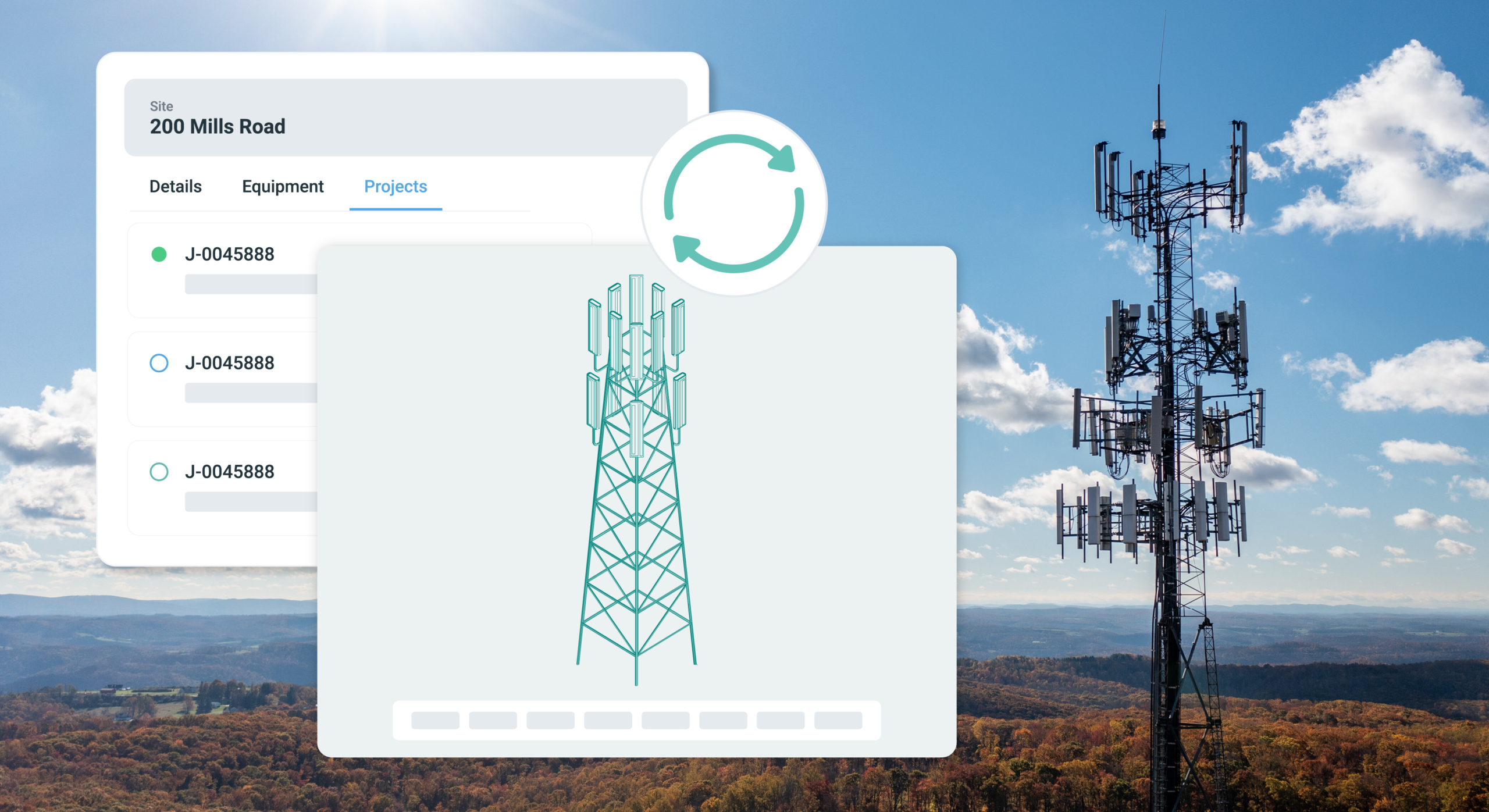
Managing wireless tower portfolios requires accurate, up-to-date site records. With 5G spectrum deployments expanding and mobile network density increasing, tower operators need detailed visibility to evaluate structural capacity, process colocation applications, and execute upgrades.
At the core of tower business valuation is understanding the capacity of the entire tower portfolio. Knowing precisely what equipment is installed, where it is positioned, and what remaining structural capacity exists allows operators to maximize their tenancy ratio—the average number of tenants co-locating on a single tower. Increasing tenancy ratios boosts recurring leasing revenue without the capital expenditure of building new towers. However, incomplete records and a lack of portfolio-wide capacity visibility often stall colocation deals.
The emergence of Synthetic Twins solves this core challenge by providing tower operators with portfolio-wide visual capacity intelligence using data already under management.
Why Portfolio Capacity Visibility Drives Tower Leasing Revenue
In wireless infrastructure, a digital twin is an interactive 3D model of a site. It reflects physical components, including tower structures, antenna elevations, mounting equipment, and ground compounds.
Unlocking total portfolio capacity intelligence directly impacts tenancy ratios and profitability for tower owners:
- Accurate Structural & Load Assessment: Engineering teams can view installed equipment, spatial positioning, and remaining wind and structural load capacity in real time across 100% of their towers.
- Fast-Tracking Colocation Applications: Telecom carriers favor tower companies that offer rapid capacity verification. Having visual capacity records ready eliminates manual research and shortens lease approval cycles.
- Monetizing Hidden Capacity: Outdated paper or tabular records often cause operators to conservatively reject new tenants due to perceived capacity limits. Visual 3D intelligence reveals actual available space and structural headroom, allowing operators to safely add revenue-generating equipment.
- Accelerating Time-to-Revenue: Eliminating reliance on preliminary physical engineering surveys reduces tenant onboarding time from months to days.
The Catch: Traditional Digital Twins Missed Portfolio Scale
While traditional photogrammetry and LiDAR 3D models provide granular detail, legacy deployment methods failed to deliver portfolio-wide capacity visibility:
- High Cost per Site: Conducting dedicated drone flights or on-site LiDAR scans across thousands of towers requires substantial capital expenditure.
- Selective Portfolio Coverage: Due to budget constraints, tower companies historically limited 3D modeling to top-tier, high-revenue, or new-build sites. This left secondary or lower-tenancy assets unmodeled—the exact sites where capacity visibility is needed most to drive new leases.
- Data Stagnation: A drone scan captures a single point in time. As tenants modify hardware or perform maintenance, static models become outdated, rendering capacity data unreliable.
When a colocation request arrived for an unmodeled tower, teams fell back on incomplete records, manual research, or expensive truck rolls to assess capacity.
What is a Synthetic Twin?
A Synthetic Twin is a 3D digital model generated directly from structured operational data, engineering specifications, and asset records already managed within a platform like Sitetracker—without requiring an initial drone flight or field survey.
Key Differences: Traditional vs. Synthetic Twins
| Attribute | Traditional Digital Twin | Synthetic Twin |
|---|---|---|
| Primary Data Source | Drone photogrammetry or LiDAR scans | Existing operational and structural database records |
| Capacity Visibility | Selective (limited to scanned priority sites) | 100% Portfolio-Wide Capacity Visibility |
| Relative Cost | Baseline cost (100%) | Up to 85% cost reduction |
| Prerequisite | Dedicated site visit or drone flight | None (uses data already under management) |
| Tenancy Impact | Accelerates leasing on select scanned sites | Drives portfolio-wide tenancy growth |
| Data Lifecycle | Requires manual rescans to stay current | Continuous enrichment via reinforcing data loops |
Technical Integration: Data-to-Twin Workflows
Integrations between Wireless Tower operational systems and 3D intelligence layers—such as the partnership between Sitetracker and 5×5 Technologies—demonstrate how synthetic twins turn site data into actionable capacity insights for tower operators.
- Portfolio Baseline Creation: Sitetracker site attributes, equipment inventories, and elevation metrics populate the 5×5 platform to build an initial 3D capacity model across 100% of tower assets.
- Automated Capacity Analysis: The visual model, combined with operational records, provides a structured dataset for agentic AI tools (such as Sitetracker’s Scout) to automate capacity checks and colocation feasibility reviews.
- Reinforcing Data Loop: When site modifications, equipment upgrades, or future drone flights occur, new “as-built” data reconciles with and enriches the base synthetic twin, keeping portfolio capacity records accurate over time.
Conclusion
Understanding total portfolio capacity is the primary lever for expanding tenancy ratios and maximizing yield across tower portfolios. Synthetic digital twins give tower operators an immediate, practical path to total portfolio visibility. By leveraging existing operational data to establish baseline 3D models across all towers, operators can evaluate capacity instantly, accelerate tenant colocation, and drive sustainable revenue growth.