Deploying AI at scale is no longer just a technical experiment—it is a core business strategy. However, as organizations move from initial AI pilots to full-scale rollouts, many hit a major bottleneck: trust.
When AI lacks proper grounding in an organization’s specific data, it runs the risk of providing incorrect, incomplete, or out-of-context answers. To achieve true return on investment and real operational adoption, AI platforms must be anchored securely to a company’s data ecosystem.
Based on the core principles behind the Scout Platform and its context engine (Compass), here is a look at why grounding your data is essential for an effective AI rollout—and the core components required to make it happen.
1. What Is an Ontology—and Why Is It Important for AI Use Cases?
In traditional data management, an ontology represents a structural framework that maps business configurations and defines how different data elements relate to one another across systems. It goes beyond simple data tables by teaching an AI system how your specific business actually operates.
By modeling these operational relationships, an ontology gives the AI the semantic context needed to navigate relational structures rather than treating distinct data points as isolated text chunks. It gives your data meaning which drives better interactions and outcomes.
Why It Matters for AI
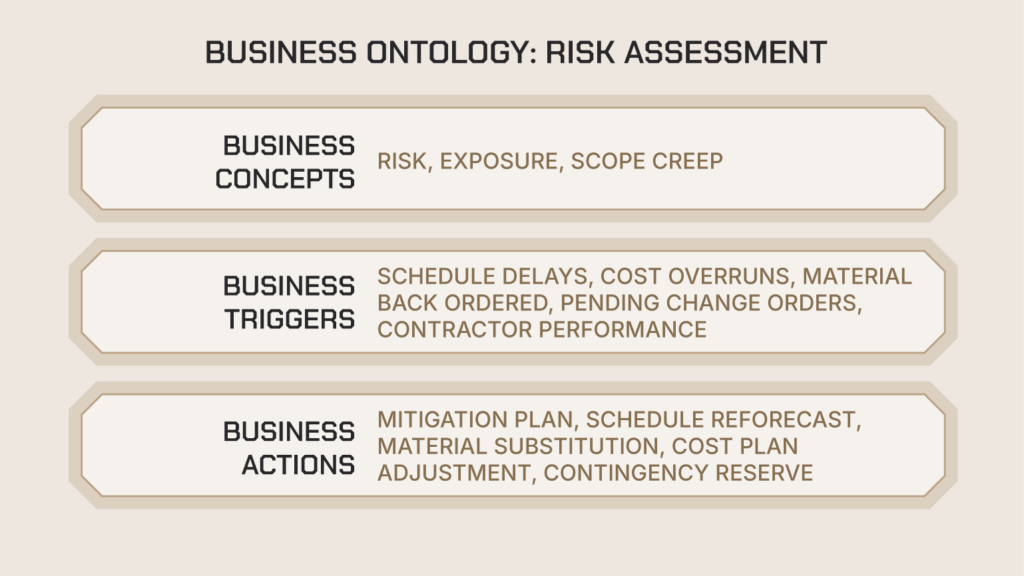
Generic AI models understand language, but they do not automatically understand your business context. For instance, if you ask an AI assistant to “find risks in a project,” a standard model might offer generic definitions of project management risks.
An ontology-driven AI platform—like Scout’s Compass—understands what specific data elements in platforms like Sitetracker or external databases contribute to a “risk” (such as missing permit milestones, material delays, or vendor dependency gaps). By understanding these underlying connections, the AI delivers answers aligned directly with your business logic.
2. How AI Hallucinates—and How to Avoid It
One of the greatest concerns enterprise leaders express when deploying AI at scale is hallucination—when an AI confidently generates false, fabricated, or inaccurate information.
Why AI Hallucinates
Large Language Models (LLMs) are fundamentally probabilistic text-prediction engines. When an LLM does not have direct access to your specific business facts, it relies on pattern matching from its broader training data to “fill in the blanks,” essentially guessing the most likely sequence of words. These guesses can at a minimum create frustration with users, or even worse lead someone down a path that is not based on ground facts.
How Grounding Prevents Hallucination
To eliminate guessing, the AI must operate strictly on grounded data. Grounding forces the AI model to draw its answers exclusively from validated, structured, and unstructured enterprise sources rather than general assumptions.
By combining real-time data retrieval with an ontology that dictates how data points connect, grounded AI platforms verify facts before generating responses—ensuring the outputs are accurate, reliable, and trustworthy.
3. Compass in Action: Tuning AI with Business Context
While understanding the conceptual need for an ontology is important, the real operational challenge is implementation: How do you teach an AI system the exact nuances of your organization without costly, time-consuming model retraining?
This is where Compass—Scout’s context engine—bridges the gap. Every enterprise implementation has tailored data structures, custom workflows, and internal naming conventions. Compass allows administrators to configure and tune this business context in plain software configuration rather than engineering complex machine learning pipelines.
Core Context & Disambiguation
Instead of letting an LLM guess how your data connects, Compass configures your data set to align exactly with your business context.
- Disambiguating Terminology: Real teams rarely use identical terminology. Within Compass, admins can map synonyms and keywords—for example, tuning the Risk so Scout understands that mentions of “hazards,” “threats,” or “blockers” refer to the exact same business entity and data fields.
- Pinned, Hidden, and Custom Fields: Admins control exactly which data fields provide the base context for every interaction. By curating what data Scout prioritizes or ignores, outputs stay laser-focused on operational reality.
Tuning vs. Retraining: Agility at Scale
With generic AI models, teaching new business rules often requires fine-tuning or prompt overhead that breaks across teams. With Compass:
- Configured Once, Shared by All: Admins define the business rules and ontology once, and every team member automatically inherits that shared ground truth across web and mobile workflows.
- Adapts as You Grow: When your operating procedures, milestones, or schema change, you simply update the tuning configuration in Compass—not the AI model.
Full Provenance and Auditability
When an AI delivers an insight—such as identifying which projects are at risk of missing schedule milestones—trust comes from transparency. Compass powers Scout’s reasoning panel, allowing users and admins to click through and see the exact objects, parameters, and grounded records used to produce an answer. There are no black-box assumptions—only verified business facts.
4. How Skills Make AI Easier and more consistent
A common barrier to widespread AI adoption is the “prompt engineering” gap. While 10% of tech-savvy power users might excel at crafting precise prompts to get optimal results, the remaining 90% of staff often face friction when trying to incorporate AI into daily workflows. This gap can make it difficult to scale the rollout of AI tools and limit the potential benefits to the wider organization.
Standardizing Interactions with “Skills”
Skills bridge this gap by encapsulating specific business interactions into structured, repeatable actions. Instead of forcing every employee to learn complex prompting techniques:
- Pre-built Skills can be created for routine tasks (e.g., automated project risk audits, permit package assembly, or vendor status checks).
- Users get consistent, high-quality results across the entire organization.
- Friction is eliminated, ensuring seamless onboarding and consistent execution for all team members, not just prompt experts.
5. Why Connectors Make the Data Used for AI More Effective
An AI platform is only as effective as the data it can access. In most enterprise environments, valuable operational data rarely lives in a single place; it is scattered across CRM platforms, project management tools, ERP systems, and cloud repositories.
Augmenting Intelligence via Pre-Built Connectors
Enterprise-grade connectors serve as secure bridges to gather data across these disparate platforms:
- Complete Context: Connectors allow the AI to pull supplementary information from external software systems to enrich its core knowledge base.
- Real-Time Data Integration: Instead of relying on static snapshots or stale data lakes, connectors fetch live operational data as work happens.
- Enhanced Accuracy: Augmenting the core ontology with multi-system connector data gives the AI the full context needed to execute complex agentic workflows—such as verifying milestone requirements across multiple enterprise tools simultaneously.
Summary: Building a Grounded Foundation
Successful AI adoption relies on moving past general-purpose chat tools toward grounded, context-aware platforms. By anchoring AI with a solid ontology, enforcing data grounding to avoid hallucinations, simplifying user interactions through skills, and connecting all enterprise data via robust connectors, organizations can roll out AI solutions that deliver measurable value and earned trust across every team.
Ready to learn more? Schedule a demo of Scout today.