Every charging network is measured on two numbers: how fast it gets new chargers live, and how reliably they stay that way. The first drives growth. The second earns driver trust.
The networks scaling fastest treat those numbers as one problem, because the decisions that speed a site to go-live are the same ones that set up its uptime for the next decade. They get there with four moves:
- Centralize every site, project, and asset on one record, from feasibility through repower.
- Standardize how sites get built, with repeatable templates, milestones, and handoffs.
- Optimize across the portfolio, using live data to spot what’s blocking go-live or dragging down uptime.
- Automate the management across the asset lifecycle, with AI that works on live records and keeps people on the decisions.
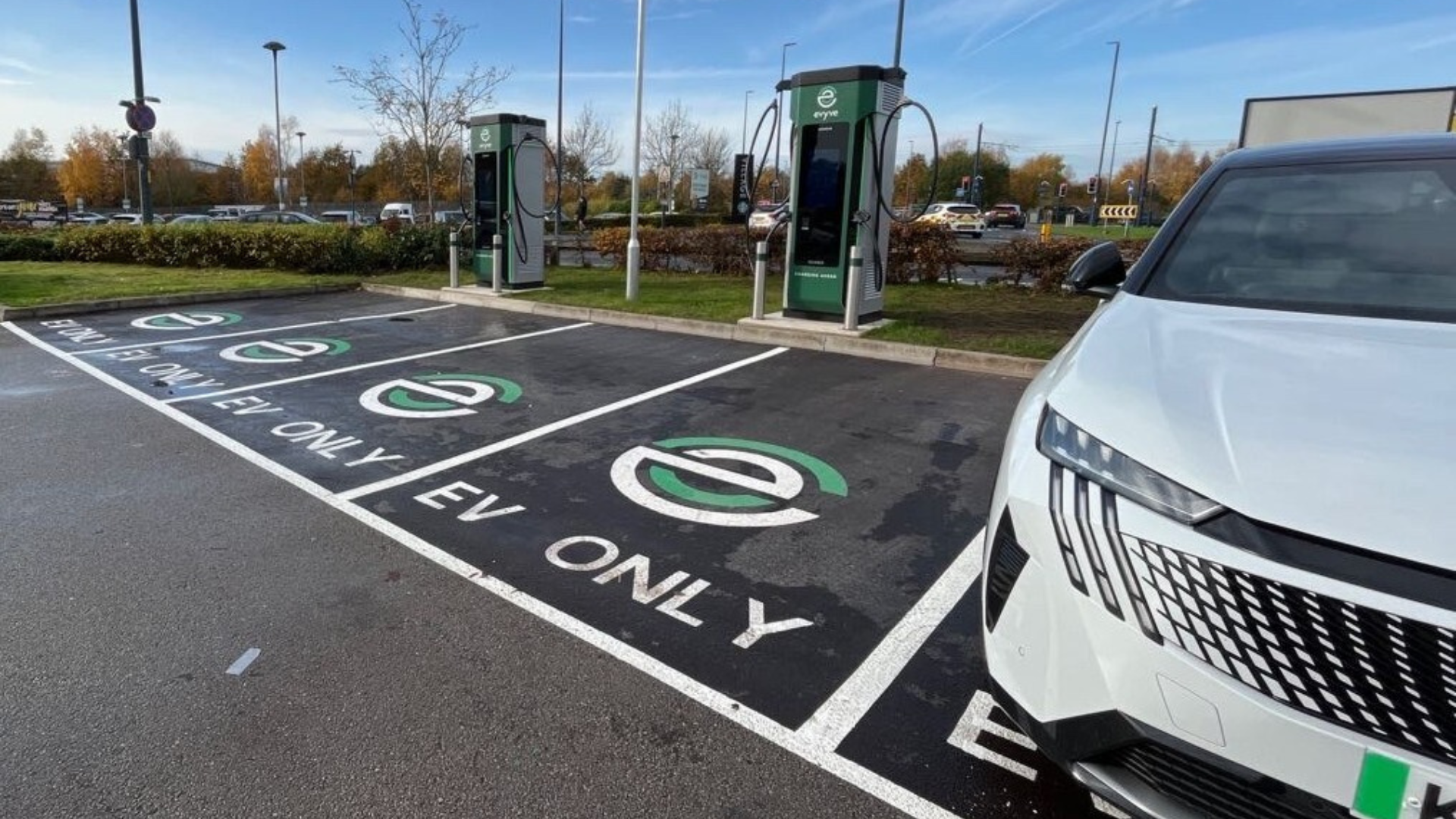
That’s how Evyve, a UK charge point operator delivering rapid and ultra-rapid charging at retail hubs, pubs, and hotels, runs its network. “Every business unit currently uses Sitetracker, all the way from pre-construction, all the way through to construction [and] operations,” says Courtney Okoyeze, PMO at Evyve.
The EV charging asset lifecycle is the full span of work required to plan, build, operate, and renew a charging site. It runs through six stages:
- Site selection and planning
- Utility coordination, power infrastructure, and energization
- Procurement and deployment
- Commissioning and handoff
- Operations and maintenance
- Upgrade, retrofit, and repower
Below, we walk through each stage: what it demands, where centralizing, standardizing, optimizing, and automating make the difference, and how Evyve’s team uses Sitetracker and Scout, Sitetracker’s agentic AI platform for infrastructure operations, to do it.
Stage 1: Site selection and planning
Site selection locks in most of a site’s economics before a shovel moves. A strong site balances driver demand (traffic, dwell time, nearby amenities) against what it will cost to power, permit, and maintain.
The classic mistake is choosing on traffic alone, then discovering the site needs a utility service upgrade that doubles the budget and adds a year. The second mistake is quieter: treating site data as a one-time planning artifact.
Host agreement terms, utility account details, access constraints, and design assumptions all matter again in year five, when a technician needs a gate code or a finance team is weighing a power upgrade.
On Sitetracker, the site record created during feasibility is the same record the project, and later the asset, builds on. Nothing gets re-keyed, so nothing gets lost. Evyve chose Sitetracker for exactly this reason: “Sitetracker gives Evyve the ability to have a single source of truth across all of our data,” says Sebastian Hymas, Head of Operations.
Stage 2: Utility coordination, power infrastructure, and energization
For many networks, the utility is the longest pole in the schedule. Getting power to a site involves two distinct pieces of work, and they’re easy to blur:
- Power infrastructure is everything between the grid and the charger: transformer, switchgear, cabling, ducting, groundworks, and service panels. In the UK it’s usually called civils and electrical works; some US utility programs call it make-ready. Many utilities and public programs fund part of it.
- Energization is the utility physically connecting and powering the new service. Until it happens, a fully built site earns nothing.
The gap between “construction complete” and “energized” is where portfolios quietly stall. Transformer and switchgear lead times can stretch past a year in some markets, and each utility runs its own process, forms, and timeline.
At portfolio scale, the job is tracking dozens of utility requests in parallel and knowing which ones are blocking which sites.
Evyve manages this in Sitetracker. The team submits up to 20 point of connection applications a month to UK distribution network operators (DNOs), the utilities that connect and energize each site. Logging each DNO response letter by hand took four to five minutes. Now the team uploads the letters to Scout, which pulls out the costs, reference numbers, reinforcement requirements, timeframes, and contacts and records them on the right project. Updating details after a reapplication “takes like 20 seconds” with Scout, Courtney says.
Stage 3: Procurement and deployment
Deployment at scale is a coordination problem more than a construction problem. One site is a project. Two hundred sites is a program, with each site carrying its own permit, utility, contractor, inspection, and hardware shipment.
Procurement decisions here shape O&M for years. Power level, connector standards (most new public sites now plan for both CCS and NACS/J3400), OCPP compliance, and warranty terms all determine how a charger can be serviced and how fast it can be fixed.
Spreadsheets hold up for the first dozen sites. Past that, teams lose sight of which sites are waiting on what, and schedule slips compound. Courtney has run projects both ways, and puts it plainly: Sitetracker “honestly saves you from using seven Excel sheets to monitor and track your project schedules.”
On Sitetracker, every site runs on a standardized project template with defined milestones, owners, and dependencies. Approvals, budgets, and construction admin live on the same record, so exceptions surface early instead of at the ribbon cutting. Scout then takes on the admin around the schedule: Evyve’s project managers use it to update schedules and records, work that used to take around 30 minutes a day.
Stage 4: Commissioning and handoff
Commissioning is the most underrated stage in the lifecycle, because it’s where construction data either becomes operational data or disappears.
Before a site goes live, the asset record should be complete:
- Charger make, model, serial numbers, and firmware versions
- Warranty start dates and coverage terms
- As-built drawings and commissioning test results
- Utility meter and account information
- Site access instructions and host contacts
- The contractor responsible for each scope
If that information stays in a contractor’s email, O&M starts blind. The first fault becomes a research project: which unit is it, is it under warranty, who installed it, who’s allowed on site?
On Sitetracker, the project becomes the asset. Commissioning data lands on the same record operations will use, so day one of O&M starts with the full history. Go-live is also one of the most manual steps in the lifecycle. At Evyve, taking a site live involves 30 to 40 data points to correct, information to send, and people to alert, which is why it’s first in line for the team’s next Scout agents.
Stage 5: Operations and maintenance
Operations is the longest stage of the lifecycle and the one drivers actually experience. Uptime at scale comes from a repeatable set of O&M workflows:
- Preventive maintenance on a schedule tied to each asset’s model, age, and usage
- Fault detection and triage that separates remote fixes from issues that need a truck roll
- Remote resolution through resets and firmware actions, which can clear a meaningful share of faults without dispatch
- Field dispatch to the right contractor, with the right parts, under the right SLA
- Warranty and RMA management so the network isn’t paying for repairs the manufacturer owes
- Compliance reporting that can stand up to an audit, not just a dashboard
Notice what these have in common. None of them is about charging sessions or driver payments. That’s the job of a charge point management system (CPMS), and CPMS platforms do it well. What a CPMS isn’t built to run is the work around the asset: who fixes it, with what, under which contract, and whether the fix held.
That’s why uptime at scale is a work management problem. Every fault needs an answer to the same questions: which asset, which warranty, which contractor, which parts, which SLA.
Multi-vendor networks make those questions harder. Evyve’s chargers come from several manufacturers, each with its own fault and maintenance system. Rather than build an integration to each one, the team imports vendor fault spreadsheets into Scout, which updates every related ticket, job, and planned site visit in Sitetracker. “We just simply import those straight into Scout on a daily basis. [It] takes us one minute every morning,” says Seb.
The result is one place to see every fault against the asset’s history, whoever made the hardware. That’s the foundation for the reliability work we’ll cover in the rest of this series, from remote triage to reporting.
Stage 6: Upgrade, retrofit, and repower
A charging site outlives its chargers. Power electronics typically need replacement well before the site’s civil and electrical infrastructure does, so every network eventually faces the same question: repair, retrofit, or replace?
The pressure to decide is rising. The NACS transition means many existing sites need connector retrofits or new dual-standard hardware. Vehicles that accept higher charging power make older, slower units less competitive. Protocol and firmware updates can leave early hardware behind.
Good repower decisions depend on lifecycle data: failure history by model, warranty status, parts availability, and utilization per port. Networks that captured that data in Stages 4 and 5 can make the call with evidence. Networks that didn’t are guessing with capital.
And repower loops the lifecycle back to the start. A site upgrade often means new power requirements, a new utility request, and a new round of civils and electrical work.
Where charging networks win or lose
Networks win when data and accountability carry across every handoff. They lose when each stage runs in its own tool and the asset’s history resets at every transition.
| Handoff | What gets lost | What it costs later |
|---|---|---|
| Site selection to utility | Power assumptions behind the site decision | Surprise service upgrades, budget overruns, delayed energization |
| Construction to commissioning | Serial numbers, firmware, as-builts, test results | Slow first fixes, missed warranty claims |
| Commissioning to O&M | Warranty terms, contractor scopes, access details | Wrong-contractor dispatches, repeat truck rolls |
| O&M to repower | Failure history and utilization by unit | Capital spent on the wrong sites or the wrong hardware |
The fix is a single system of record that follows the asset from site selection through repower. When a project becomes an asset without being re-keyed into a new tool, the team fixing a charger in year six sees the same history the team that sited it in year zero did.
That shared record is also what makes AI useful in operations. Evyve already pays for the major general-purpose AI platforms and gets real value from them. The friction was the round trip: export data from Sitetracker, add context so the tool understands the business, then put the results back by hand. “With these generic AI tools, sometimes more context has to be added to the query,” Courtney says.
Scout removes that loop because it works directly on live Sitetracker records. “The value for us in Scout over a generic AI was specifically the ability of Scout to read and write live data in Sitetracker,” says Courtney. Every answer traces back to the records it came from. When the data isn’t there to support an answer, Scout declines and escalates rather than guessing.
People stay on the decisions. “AI completes the task and just presents me with a review to approve or disapprove,” Courtney says. That review step has paid off beyond speed: “it’s significantly reduced the amount of errors, which was previously affecting a lot of our board-level reporting.”
For a team of 20 to 25 people running a UK charging network, that adds up. “Scout gives us the ability to punch well above our weight without having the need to go and hire tens more people directly into the organization,” says Seb.
The value isn’t a smarter model. It’s grounding and governance a generic model can’t give you, applied where uptime is actually won.
See how Sitetracker supports EV charging networks across the full asset lifecycle, or explore our EV charging project management strategies.