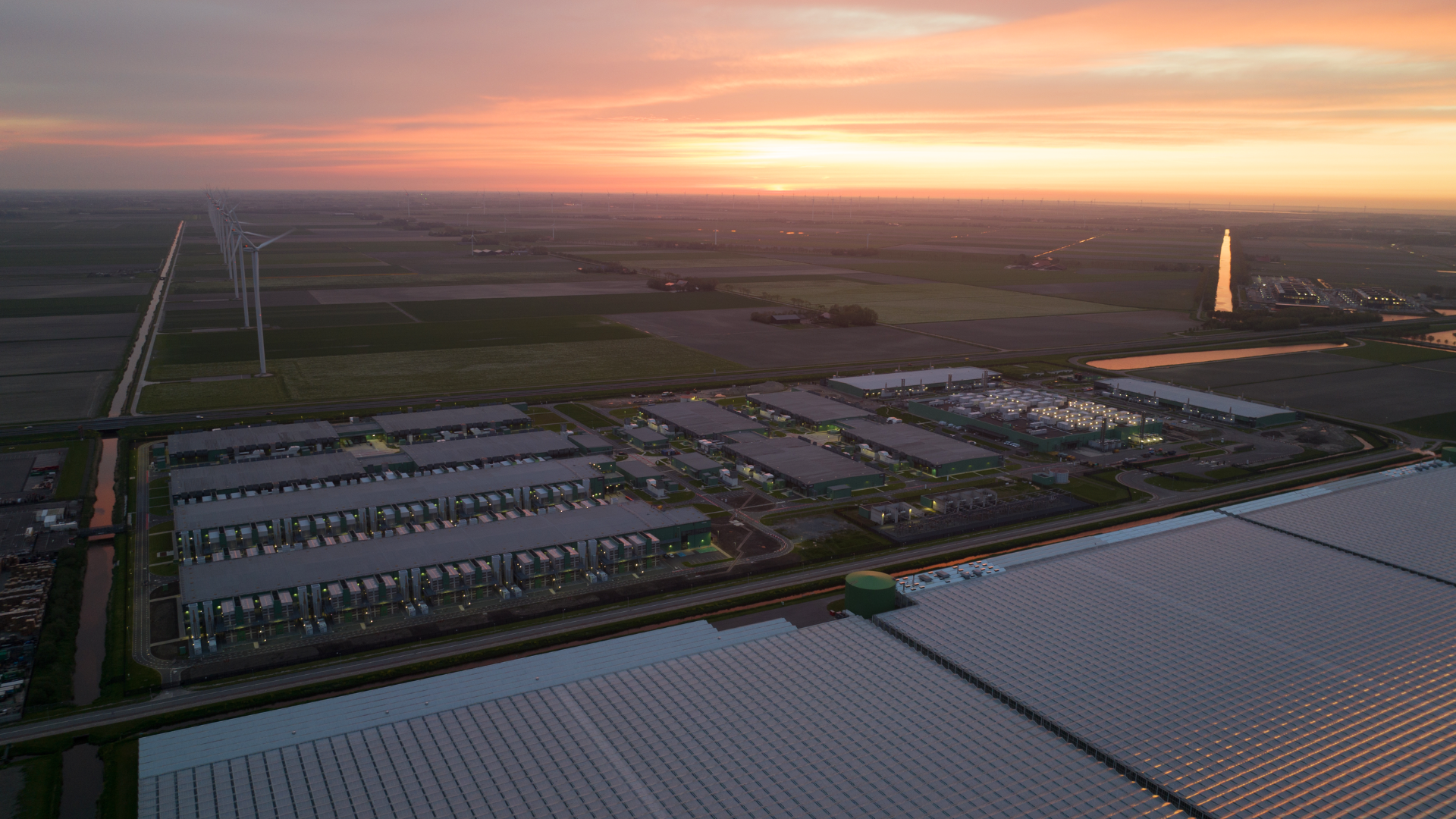
The European data center market is at a structural inflection point. Fueled by explosive demand for artificial intelligence (AI) and increasing pressure for digital sovereignty, the industry is shifting from traditional cloud expansion to AI-driven hyper-expansion.
In 2026 alone, more than 750MW of new capacity is expected to come online across Europe, that’s roughly equivalent to the entire colocation capacity of France just one year prior.
As the concept of the “AI factory” becomes the new infrastructure blueprint, data center operators must adapt to:
- Higher compute densities
- Compressed deployment timelines
- The need for real-time operational visibility
Below are the key trends shaping the future of data centers in Europe based on what we learned at Data Centre World 2026 in London.
AI Workloads Are Stress-Testing Existing Infrastructure
One of the biggest misconceptions in the market is that AI requires entirely new data center models.
In reality, existing colocation (colo) infrastructure is still highly viable. Large-scale AI workloads, hundreds of megawatts worth, are already being absorbed into current environments.
So what’s changing is not the model, but the requirements:
- Higher rack densities (e.g., 48kW and beyond)
- Increased thermal tolerance
- Faster deployment timelines
- More dynamic cooling strategies
This moment is less about disruption and more about transition. Data centers are evolving to meet new demands, not being replaced by them.
The Rise of the “Single Pane of Glass”
Fragmented systems are no longer sustainable in high-density, AI-driven environments.
Traditionally, BMS (Building Management Systems) and EPMS (Electrical Power Monitoring Systems) have operated in silos. This fragmentation slows decision-making and increases operational risk.
The shift:
- Unified platforms integrating energy, thermal, and security data
- Real-time monitoring and predictive diagnostics
- Convergence of OT (Operational Technology) and IT systems
Why does this matter so much? A “single pane of glass” enables faster decisions, improved uptime, and better resource optimization, which is critical in AI-scale environments.
Digital Twins Are Becoming the Operational Brain
Digital twins are evolving from static design tools into dynamic, real-time operational systems. What was once a BIM (Building Information Modeling) artifact is now a living layer of intelligence.
Modern digital twins can:
- Match IT load to cooling demand in real time
- Detect anomalies before they escalate
- Provide granular control at the rack or site level
- Optimize energy and thermal performance continuously
This shift marks a major evolution: the data center is no longer just built, it’s continuously modeled, analyzed, and optimized.
Speed to Deployment Is the New Competitive Edge
In Europe’s data center market, speed is no longer optional, it’s a critical requirement. Why? Because there’s a new benchmark: Sub-12-month timelines from demand to operational infrastructure.
How operators are achieving this:
- Modular construction and prefabrication
- Standardized design templates
- Parallel execution across power, cooling, and IT layers
The challenge remains, managing the complexity of the “GPU stack” from hardware to power infrastructure, while maintaining visibility across multiple sites and regions.
Sustainability Is Shifting from Targets to Transparency
Sustainability is no longer a branding exercise, it’s a regulatory and operational necessity.
Key pressures:
- Power constraints: 67% of operators cite access to energy as their top challenge
- Water usage: Liquid cooling is increasing scrutiny on water sourcing
- Net-zero commitments: Rising AI demand conflicts with emissions goals
Emerging solutions:
- On-site power generation (e.g., gas turbines, battery storage)
- Advanced energy optimization tools
- Greater transparency in environmental reporting
The reality is that balancing AI growth with sustainability goals is one of the industry’s most complex challenges.
The Missing Layer: Program Management at Scale
Much of the industry conversation today is centered on two primary layers: the infrastructure layer, which focuses on power and cooling, and the operational layer, which focuses on monitoring and optimization.
But there’s a critical layer that often goes overlooked: program management and deployment coordination.
Building modern data centers, especially for AI, requires managing a complex stack:
- Client requirements and workloads
- Data center hardware (servers, GPUs, networking)
- Site and power infrastructure
Coordinating these layers involves: vendor management, procurement and logistics, site readiness and construction, and milestone tracking across multiple locations. At scale, this becomes a massive orchestration challenge—one that cannot be managed effectively with spreadsheets or disconnected tools.
Conclusion: Building the AI-Ready Data Center
Europe’s data center industry is undergoing a fundamental transformation.
The rise of AI factories is not just increasing demand, it’s reshaping how infrastructure is designed, deployed, and operated.
Operators that succeed will be those who can:
- Adapt existing infrastructure for high-density AI workloads
- Unify operational visibility across systems
- Leverage digital twins for real-time optimization
- Accelerate deployment timelines without sacrificing control
- Balance performance with sustainability requirements
- Manage the program at scale to scale
The next generation of data centers will not just support AI, they will be purpose-built for it. To learn more about how Sitetracker helps today’s leading Data Center organizations in building the intelligent backbone of tomorrow’s digital ecosystem, click here.
FAQs
AI is not making existing data centers obsolete; it is stress-testing them. While new “AI Factories” are being built, roughly 300MW of AI workloads are currently being absorbed by existing infrastructure through fit-out optimizations and higher rack densities.
The primary risk is the “Silo Tax” which is inefficiencies caused by fragmented Building Management Systems (BMS) and Electrical Power Monitoring Systems (EPMS). Without a “single pane of glass” to unify these systems, operators face slower decision-making and higher risk during rapid deployments.
Digital twins have evolved into a “live operational brain”. Instead of being static handover documents, they now match IT loads to cooling demand in real-time and provide predictive diagnostics to prevent outages before they occur.
The GPU Stack is a framework for integrated delivery consisting of three layers: the Client Layer, Data Center Hardware, and Site & Power Infrastructure. Success in the AI era requires managing all three layers simultaneously rather than in isolation.
With record-low vacancy rates and surging demand, the ability to move from customer demand to live infrastructure in under 12 months is now the industry expectation.